
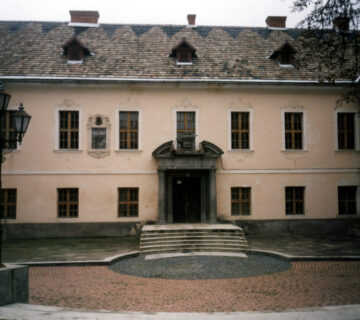
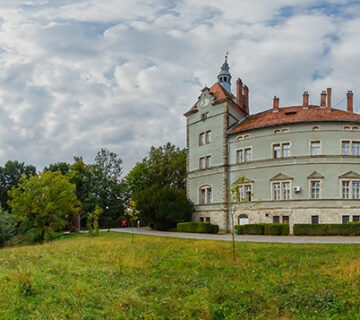
Uzhhorod Castle
The castle dates back to the 9th century. It was a stronghold on one of the hills above the settlement of white Croats. At that time, the castle looked like a wooden fortress consisting of a cubicle and a palisade. Back then, this area was inhabited by Slavs - White Croats. There was a principality here, headed by Prince Laborets.
The chronicler of the Gesta Hungarorum notes that Uzhhorod Castle and the entire surrounding area belonged to Laborets. In the late tenth and early eleventh centuries, when the plain part of Transcarpathia fell under the rule of the Kingdom of Hungary, a stone castle was built in Uzhhorod as the administrative centre of the Ung comitatus. It was already a powerful defensive structure, the strength of which is evidenced by the fact that in 1086, during the raid of the Polovtsian horde led by Khan Kutesk, which broke through the Carpathian passes to the Danube lowlands, the nomads failed to take Uzhhorod Castle. Historical documents confirm that stone castles in Transcarpathia began to be built very intensively after the Tatar invasion. Although the Tatars withdrew, the fear of the Magyars remained, and King Bela IV ordered the fortification of castles at strategically important points.
During the period when the castle was owned by the Druget family (1322-1691), great changes took place in the art of fortification, caused mainly by the emergence of new types of weapons, and primarily firearms. All of this required a radical reconstruction of the castle, which was carried out at the end of the 16th century using the latest achievements of European fortification art.
The Uzhhorod Castle was completely reconstructed by Italian engineers to strengthen its defences: stronger walls were built at a certain distance from the palace, and a diamond-shaped bastion, 10-15 m high, was built at each corner, extending beyond the line of the square walls. Cannons were placed on the bastions' platforms to keep the approaches to the castle under fire. To strengthen the strength of the bastions, their horns were lined with square slabs of white stone.
The castle was almost impregnable. Its impregnability is especially emphasised on the north side by the massive row of high walls, devoid of even loopholes. The walls are built of stone. The northern part of the castle was protected by a keel-shaped bastion. The castle was an irregular quadrangle in plan, due to the relief of the Castle Hill. The building was surrounded on three sides by a moat 8-10 metres deep, through which a drawbridge was thrown to the entrance gate. The holes for the chains used to raise the bridge have been preserved to this day. The thickness of the outer fortification wall ranged from 2.5-3 metres to 10 metres in height, and it has been preserved to this day.
Since 1947, the castle has been used as a local history museum.
The architectural monument has become one of the most visited tourist attractions in Uzhhorod and Ukraine. In 2009, Uzhhorod Castle took second place in the 7 Wonders of Transcarpathia competition.
The Transcarpathian Regional Museum of Local Lore named after Tyvodar Lehotskyi is located in Uzhhorod Castle.
The museum's website is https://www.zkmuseum.com/p/uzhgorod-castle-uzhhorod-castle.html


No comment