
Palace of the Princes of Rakoczy
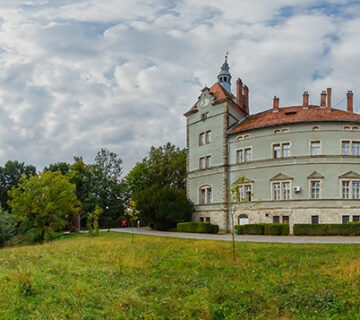
The Palace of the Rakoczy Princes (also known as the White Palace) is a former palace of the Rakoczy princes of the Transylvanian dynasty, located in Mukachevo.
Construction of the one-storey Baroque palace began in 1667. The White Palace (or House) got its name because of the white colour of its facade. [1].
In his work Monograph of the Beregsky Komitat (1881), Tyvodar Lehotskyi gives a detailed description of the building:
In 1746-1747, the one-storey building was rebuilt and significantly expanded according to the project of the famous German architect Johann-Balthasar Neumann. It was a rather complicated reconstruction. It was necessary to use the old elements of the buildings, add another floor and a new building in compliance with architectural proportions and symmetry. This is how the palace got its U-shape. The façade has two original windows and 5 reconstructed windows in the Renaissance style. An open staircase leads to the main entrance.
In the 19th century, the columned portal of the main entrance, carved from Timpanogos stone, was built. In the middle of the entrance there is a vase-decoration. The windows of the main façade and the vaults of the palace premises are decorated with shtuk (stucco). The interior spaces of the middle wing of the building have a domed vault. Now there are 21 rooms, 98 windows, 91 doors and 10 ancient stoves.
To the left of the main entrance, between two windows, there is a richly framed plaque in honour of Ferenc II Rákóczi, erected in 1911, which remained intact during Soviet rule.
The palace was built by the princes of the Transylvanian dynasty Rakoczyas a city residence. They lived there until 1711. After the suppression of the national liberation war of 1703-1711, led by Ferenc Rákóczi II, the palace first became the property of the Austrian emperor, and then, in 1728, was transferred along with vast land holdings as a gift to the German Count Schönborn-Buchheim. "The White Palace was used for ceremonial receptions of the nobility and foreign ambassadors.
In the nineteenth century, the palace housed the exhibition of the Mukachevo Museum of Local Lore, founded by the famous Transcarpathian archaeologist Tyvodar Lehotskyi. There was also the office of Count Schönborn, where T. Lehotsky worked as a lawyer.
Since 1945, when Transcarpathia became part of Soviet Ukraine, the palace has housed the headquarters of the Soviet Army. Later, one of the city's secondary schools was located here.
In 1979, the first children's art school in Transcarpathia named after Mihály Munkácsy was opened in the palace[3]. In 1969, a memorial plaque was erected in his honour[4].


No comment