
Mukachevo castle "Palanok"
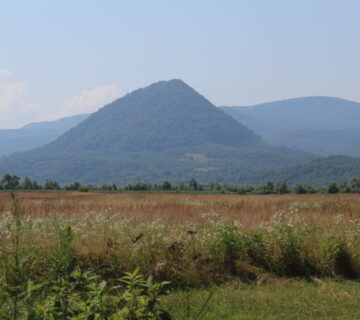
The majestic and glorious Palanok Castle stands on a mysterious hill of volcanic origin.
The history of ancient Mukachevo goes back centuries: the remains of Slavic settlements found by archaeologists in the city date back to the VI-IX centuries. It was during this period that the first mud-brick fortifications and later a wooden castle appeared on Castle Hill. In the eleventh century, Hungarian King Laszlo I the Holy ordered the construction of a stone fortification here because of the threat of nomads from the east. And he was not mistaken. Already in 1086, the Polovtsians attacked Palanok.
Later, the fortress was stormed by the Mongol army with Batu Khan. The constant military threat prompted the construction of the castle. The fortress was surrounded by a water moat, drawbridges, an earthen rampart (8 m), and bastions.
One of the famous owners of the Mukachevo Castle was Prince Fedir Koryatovych of Podillia, who received the land from his relative, the Hungarian king, in 1396. The people honoured the good prince and immortalised his name in many legends. In one of them, Fedir Koryatovych saves the peasants from the bloody robber Brynda. In another, he deceives the devil himself to dig a well in the castle (85 metres deep). To this day, people believe in the magical power of the legendary prince. One has only to take his bronze figure standing in the castle by the finger, make a wish... and it will certainly come true.
During the 15th and 16th centuries, the fortress's defence system grew to 14 towers, and a magnificent palace grew in the upper part. The Transylvanian princes of the Rakoczy dynasty, who owned the castle from 1633 to 1711, invited French fortification engineers who turned Palanok into a truly impregnable fortress.
Suffice it to recall the siege of 1685-1688, when a small garrison of the Mukachevo castle, surrounded by an entire army of Austrians, heroically defended itself under the command of a beautiful woman, a ruler sung in legends - Ilona Zrinyi. The Austrians took the fortress with the help of tricks, and the courageous princess was sent to a monastery by force. In 1703, the Palanok became a stronghold of the Hungarian national liberation war - the residence of the leader of the uprising, Count Ferenc II Rákóczi (son of Ilona Zrinyi). The long struggle against the Habsburg Empire ended with the Hungarians' surrender in 1711, but the fortress stood to the last.
The Austrians turned the mighty fortress into the largest imperial political prison, which lasted until 1896. After the fall of the Bastille, dissidents from all over Europe were sent here. In the nineteenth century, Mukachevo Castle became the place where the greatest relic of the Hungarian state, the Crown of St Stephen, was kept for three months. This relic is sometimes called a symbol of the past and present of united Europe. Today, the Palanok is one of the most significant monuments of fortification architecture in Ukraine.
The Mukachevo Historical Museum is open for guests here. https://www.facebook.com/Palanokmuseum/ - with a diverse exposition, there is a castle chapel.


No comment