
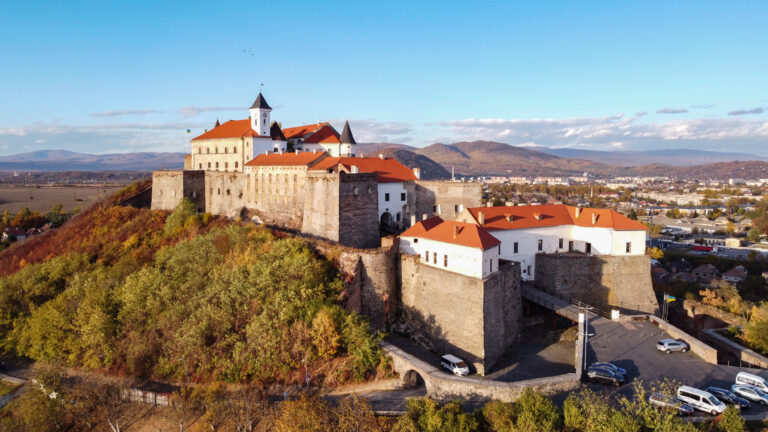
Mukachevo district

The district was established in accordance with the resolution Verkhovna Rada of Ukraine 17 July 2020. It includes: Mukachevo, Svalyava city, Nyzhnivoritske, Velykoluchkove, Verkhnekoropetske, Horondivka, Ivanovo, Nelipynske, Polyanske rural, Volovets, Zhdeniyevo, Kolchynske, Chynadiyevo settlement territorial communities.
Previously, the district's territory was part of Mukachevo (1953-2020), Volovets, Svaliava districts, which were liquidated by the same resolution of the Verkhovna Rada.
History
Located at the crossroads of trade routes, Mukachevo district has been inhabited by people since ancient times, as evidenced by the Paleolithic and Late Neolithic sites discovered by archaeologists. In the vicinity of Mukachevo, there was a fortified settlement of Halish and Lovachka. The artefacts found by archaeologists confirmed that a Celtic metallurgical centre (the second largest in Europe) was located here in the third century BC.
About a thousand tools used in the household (shears for shearing sheep, scythes, grain grinders, anvils, shields, etc.) were found at the excavation site. But an even more important discovery for archaeologists was the burial of ancient Slavs near the village of Kushtanovytsia in the VII-III centuries BC, which became known as the Kushtanovytsia culture.
The territory of Mukachevo district has been inhabited since ancient times. The district was formed around the city of Mukachevo, which grew up near the Palanok Castle. The district received its legal status for the first time in 1376, when Queen Erzsébet of Hungary presented the city of Mukachevo with a charter for the right to use its own seal to seal documents.
Mukachevo district is located in the western part of Zakarpattia region, bordering on Uzhhorod, Berehove and Khust districts. The administrative centre is the city of Mukachevo. The international motorway E50, which connects Western Europe with Ukraine, passes through Mukachevo district,
and the Lviv - Chop railway line.
One of the largest rivers in Zakarpattia, the Latorytsia, flows through the district.
Architectural monuments
In the Mukachevo region, it is worth visiting St Michael's Church, which was built without a single nail and belongs to the Lemko type. It was consecrated in 1588 and rebuilt in 1759. Next to the church stands a stone bell tower, which was erected in 2000.
The Holy Trinity Cyril and Methodius Convent (1996), where about thirty sisters are currently carrying out their monastic obedience.
The Church of the Assumption of the Blessed Virgin Mary is a Roman Catholic church built in 2010 on the site of a former shrine that was moved to Svaliava from Drachyno and built by German immigrants. Today, the parish is served by the Salvatorian Fathers (Society of the Divine Saviour) and nuns from the community of the Sisters of Charity of St Vincent.
Mukachevo Castle "Palanok" (XIV-XVIII centuries);
The Rakoczy Palace, or the White House (1667-1748);
St Martin's Chapel (14th century);
St Nicholas Monastery: St Nicholas Church (1789-1806), cells with a bell tower (1772) in Mukachevo;
Mukachevo City Council "Town Hall Building" (1906);
St. Dmitriy's Church (17th century, rebuilt in 1758 and 1910);
The unique "Palace of Count Schönborn" (1890-1895), which is located on the territory of the Karpaty sanatorium;
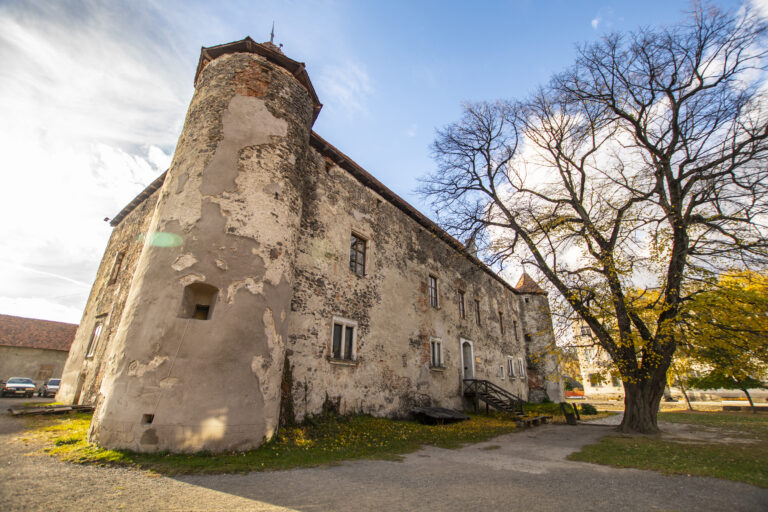
St Miklos Castle (XV-XVII centuries) in the village of Chynadiyovo;
A 17th-century wooden church in the village of Vilkhovytsia.
Holy Spirit Church (XVIII century) in the village of Huklyvyi;
St Nicholas Church (early eighteenth century) in the village of Zadilske. It is a wooden two-storey church with a bell tower (early twentieth century);
The Church of the Holy Spirit (late eighteenth - nineteenth centuries) in the village of Kotelnytsia. A wooden three-storey church (XVIII - XIX centuries) with a bell tower of the XIX century;
The monastery of the Mother of God of Kazayan in the village of Kotelnytsia;
The Church of the Assumption of the Blessed Virgin Mary of 1898 in the village of Tyshiv;
Church of St. Basil the Great. Church of St Basil the Great in the village of Zadilske;
Church of the Ascension of the Lord of the eighteenth and nineteenth centuries in the village of Yalove;
The Church of the Assumption of the Blessed Virgin Mary of 1804 in the village of Abranka;
The Church of the Ascension in 1947 in the village of Perekhresnyi.
Mukachevo district is part of the ethnographic region of Boikos, which is one of the four known historical and ethnographic groups of the Ukrainian Carpathians - Hutsuls, Boikos, Lemkos and Dolynians. The life and way of life of the Boikos has significant differences in everyday life, customs, rituals and material culture.
Natural monuments
The Obavsky stone is the vent part of the volcano, a pile of stone blocks;
Lake Syne, near the village of Synyak at an altitude of 600 m above sea level. The water in the lake is hydrogen sulphate-calcium sulphate, with healing properties.
The blue rock outcrops near the village of Synyak are exposed pre-glacial rocks under the top of Mount Buz, which gave the area its name.
The Skakalo Waterfall (Lower Grabivnytsia) was formed at the site of volcanic rocks outcrop, on a mountain stream in the valley of the Syniavka River (right tributary of the Irshava River of the Tisa River basin). A stone ridge crossing the forested hillside blocks the water flow here, and the stream falls off the ledges in three levels, forming a 7-metre-high cascade of streams.
Reserves: Pikuy, Golitsa, Rosishny, Temnatyk, Osa Stream, Maidan;
Healing springs: "Holy Well" in the village of Huklyvyi and "Life-giving Source" in the village of Kotelnytsia;
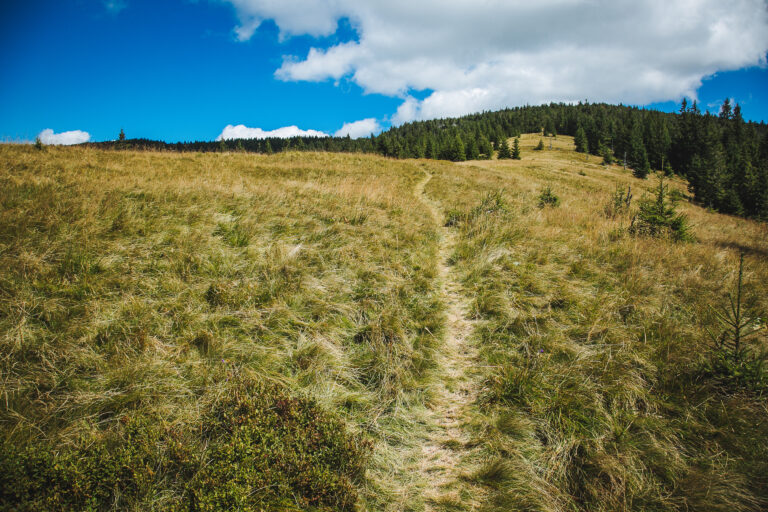
Mountains: Pikuy (1408 m) on the border with Zakarpattia and Lviv regions, Ostra (1405 m), Temnatyk (1343 m) near Volovets, Plai (1330 m), Velykyi Verkh (1598 m) and passes: Volovetskyi or Beskydskyi (974 m) and Veretskyi (838 m).
The Arpad Line bunker in the village of Verkhnia Hrabivnytsia and the Grun Hof military estate in the village of Huklyvyi.
Walking tourist routes
To Mount Temnatyk. It is convenient to start from the village of Volovets;
To Mount Play. Tourists can climb to this peak from both Volovets and Huklyve villages;
To the mountain Velykyi Verkh. You can start climbing to the top from Volovets, Huklyve, Pylypets, Veretskyi pass;
Mount Buzhora, the ascent to this peak in this area is carried out from the village of Yabluniv;
The most popular routes to Pikuy are to climb to the top from the villages of Bilasovytsia and Shcherbovets; to Mount Ostra, tourists can climb from the villages of Perekhrestnyi, Roztoka and Kichernyi.
Recreation and festivals
In the Mukachevo region, you can not only visit interesting places and have fun, but also improve your health. There are many springs with alkaline carbon dioxide waters (which are used to treat patients) within the district, near which there are sanatoriums such as Sinyak, Polyana, Karpaty, Kryshtaleve Dzherelo, Sonyachne Zakarpattya, Kvitka Polonyny and others.
The recreational area of Zhdenievo village with its numerous campsites and hotels providing services for different groups of tourists should be mentioned separately.
There is an opportunity to go paragliding (Borzhava meadow), go quad biking, mountain biking, skiing and snowboarding.
Throughout the year, various cultural events and festivals are held in Mukachevo district, including the following:
Red Wine Festival (Mukachevo);
St Martin's Day (Mukachevo);
"Varosh beer (Mukachevo);
Ogyn and Mnyaso gastronomic festival (Mukachevo);
Silver Tatosh historical reenactment festival (Chynadiyevo);
"Ringing pearls of Verkhovyna" (Volovets)
Tourists and guests of the area can stay in modern hotels, campsites, rural estates and taste regional cuisine in local restaurants.

