
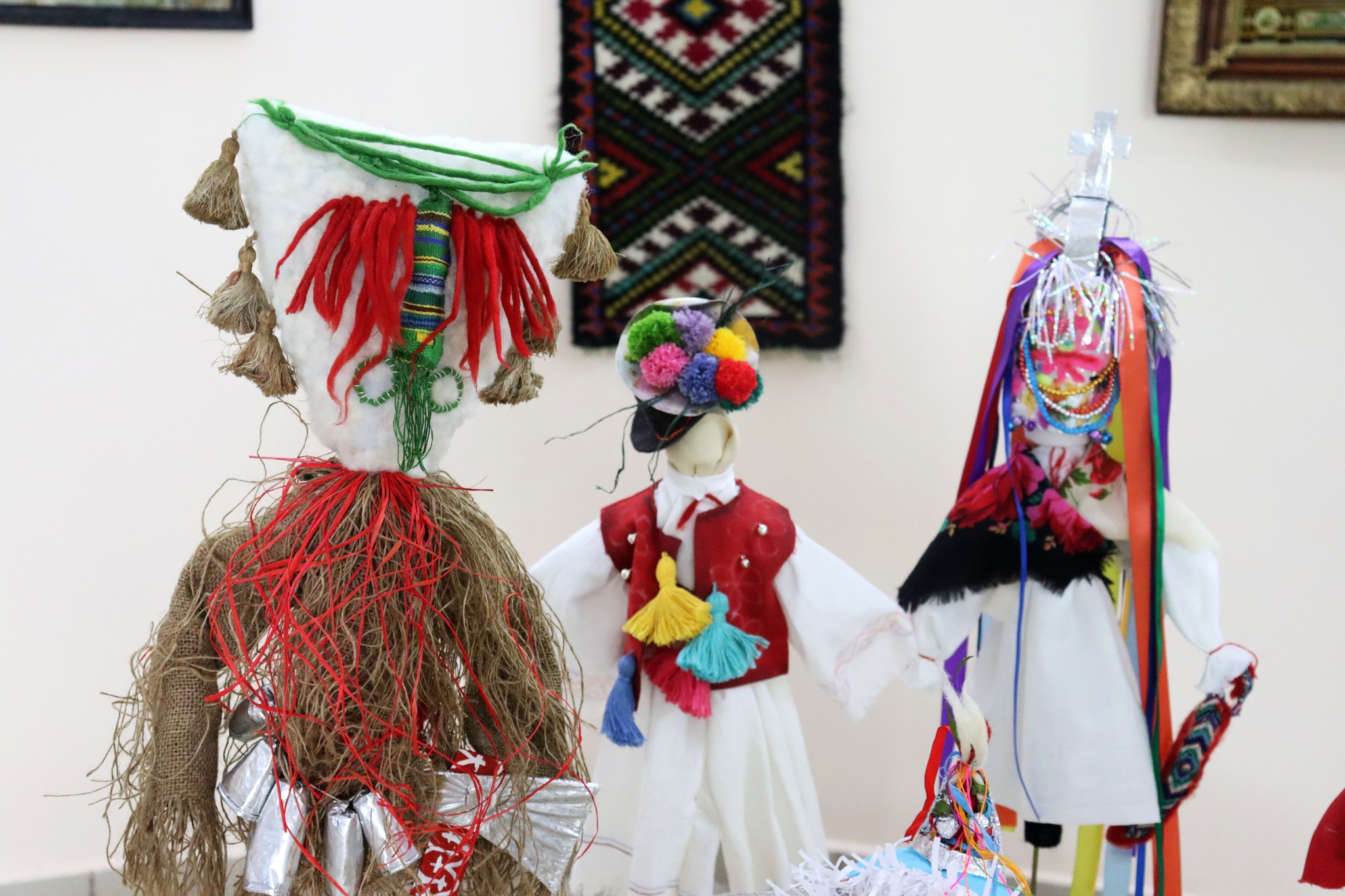
Exhibition "Symbols of Christmas of Ukrainians of the Carpathians"
Exhibition "Symbols of Christmas of Ukrainians of the Carpathians" opened in Uzhhorod Skansen
The exhibition features exhibits from the collection of our museum and the puppeteer Sylvia Illar.
The museum's collection contains interesting, unique items that embody the symbols of Christmas. They are presented at the exhibition and successfully combined with icons (lithographs) dedicated to the winter calendar and ritual cycle of holidays. On the walls are bright woolen carpets by Anna Smerdul, a craftswoman from Rakhiv district, successfully combined with items of winter outerwear (fleecy white Huni) and men's hats (kresani hats), complemented by wooden carvings: a pipe (by Ivan Palatash) and a decorative stick (by Fedir Babynets).
The central element of the exhibition, around which the exposition is built, is the "betleham" (puppet carolers), placed in the centre of the hall and symbolising a group of Christmas carolers. The composition was created by Sylvia Illar, a native of Uzhhorod.
The Christmas vernissage combines the following Ukrainian symbols: a straw didukh ("sheaf"), an eight-pointed star, a candle, a shopka, and a Christmas amulet - a "spider". The whole group together creates an incredible atmosphere of Christmas celebration in the Carpathians.
A star, an attribute of carolers, which is identified with the star of Bethlehem that illuminated the birth of Jesus. Its eight corners symbolise the eighth day after the creation of the world. And the fact that it rotates indicates its affinity with the sun, which during the Christmas holidays was turning to spring.
Didukh is an ancient symbol of Christmas, as well as a link between generations that must continue unbroken, a symbol of wealth and prosperity, a talisman of peace and family life. In some areas, it was simply called a sheaf ("snup"), and in some places, a "New Year's sheaf" (because it was kept in the house until the New Year). This sheaf symbolised the abundance of bread and millet until the new harvest (all year round).
Shopka is a model of a stable in Bethlehem. Together with the main characters, it symbolises the place where the little Jesus was born. It could be either miniature or large-scale.
A candle lit on Christmas Eve has many meanings. On the one hand, it symbolises a person's life from baptism to death and their readiness to meet God. On the other hand, the flame of a candle in a home shows mercy, warmth and light that spreads from person to person.
An ancient folk-Christian rite of glorifying Jesus Christ with carols, when carolers act as angels bringing good news.
Straw spider - according to biblical legend, a spider weaved an entrance to the cave where Mary hid her baby from Herod's soldiers. Perhaps that is why, according to ancient beliefs, the Christmas spider, made up of lightweight rhombuses and pyramids woven from straw, also had the ability to ward off evil and fill the house with light and strength.
The exhibition on view is one of the variants of exhibiting traditional folk Christmas symbols embodied in museum monuments.
We sincerely invite you to visit the exhibition until 20 January


Leave a Reply