
Uzhhorod district

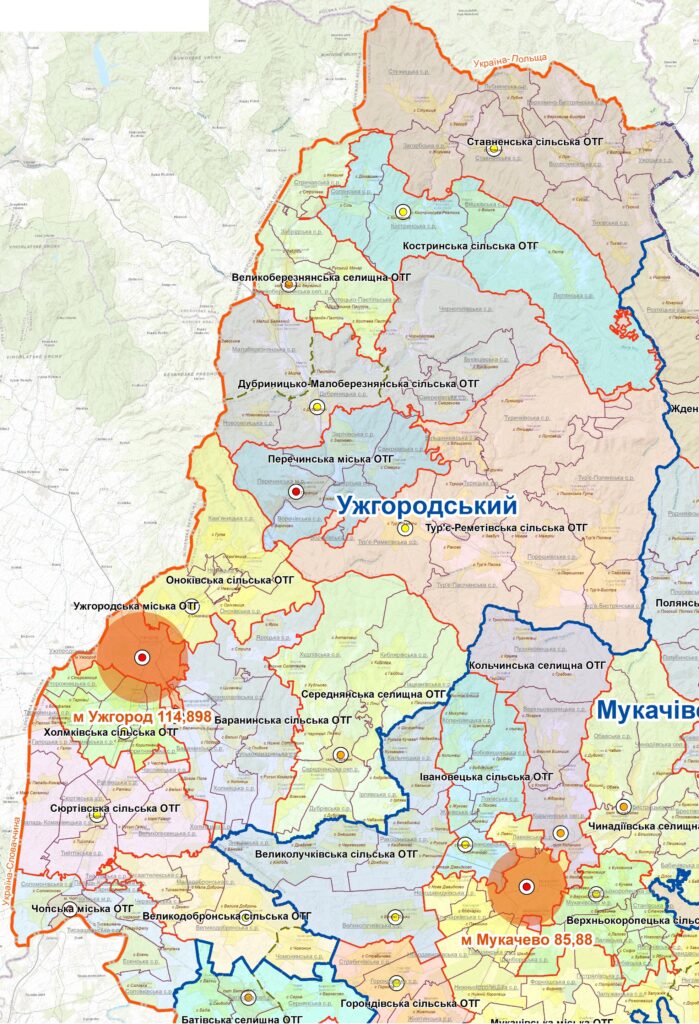
The district was established in accordance with the resolution of the Verkhovna Rada of Ukraine on 17 July 2020 and includes: Uzhhorod, Chop, Perechyn urban, Kostrynka, Stavne, Dubrynytsia-Malobereznytsia, Turye-Remety, Baranyntsi, Velykodobronka, Onokivska, Syurtyvska, Kholmkivska rural, Velykyi Bereznyi, Serednyi village territorial communities.
According to archaeologists, the territory of Uzhhorod district has been inhabited since the Stone Age - stone tools and blanks (nuclei), knife-like plates, incisors, chopping tools, etc. have been found at the sites. The Mesolithic (Middle Stone Age) monuments in Uzhhorod district, discovered by archaeologists near the villages of Barvinok, Hlyboke, Huta, Kamianytsia, Nevytske, Solotvyno, Serednie, date back to the XI-VII millennium BC. Neolithic settlements have been discovered near the modern villages of Velyka Dobron, Mali Heyivtsi, Palad-Komarivtsi, Tarnivtsi, Kholmky, Kholmok, Serednie, and the Uzhhorod neighbourhood of Dravtsi.
Uzhhorod district borders on Mukachevo and Berehove districts, as well as three countries of the European Union: Hungary, Slovakia and Poland.
Uzhhorod district is home to the largest city in Zakarpattia - Uzhhorod (115,000 inhabitants), which is the administrative, business, scientific, educational, cultural and sports centre of the region. The city of Uzhhorod was first mentioned in the chronicle of Shimon Kezai in 872, and the city is also marked by the Arab historian Al-Idrisi on a map of 1154 as Gunkbar or Ung.
In ancient times, Uzhhorod and its surroundings were areas where European grape varieties were grown and used to make wine, which was in turn exported to Poland, Slovakia and Hungary. Today, the city and the district are reviving the culture of production, and there are tasting rooms (Uzhhorod, Serednye) where you can talk about taste and hear many interesting stories about Transcarpathian wine.

Interesting fact
The westernmost point is located on the territory of Uzhhorod district: 22°09′ E; 48°27′ N (1.5 km from the village of Solomonovo), as well as the lowest point above sea level in the region (101 m above sea level), which is located near the village of Ruski Heyivtsi.
Part of the territory of Uzhhorod district is occupied by the Transcarpathian lowland, which is adjacent to the Middle Danube lowland (Panonia). The Tisa, Uzh and Latorytsia rivers play a significant role in shaping the relief. In addition, there are many artificial canals in the lowlands, as well as many ponds and reservoirs. The north of the Uzhhorod district is a picturesque mountainous area with forests dotted with valleys around rivers and streams. The highest point above sea level (1479 m) is located in the Runi valley. Slightly lower are the Gostra meadow and the Mala Ravka and Kremenets mountains. These and other peaks are part of the mountain ranges of the Ukrainian Carpathians.
Flora and fauna
Flora and fauna of Uzhhorod district: Hungarian lilac, comfrey, Kochi cornflower, long-leaved cornflower, beautiful thyme, four-membered phytheuma, clove, Transcarpathian marigold, common snowdrop, Heifel saffron.
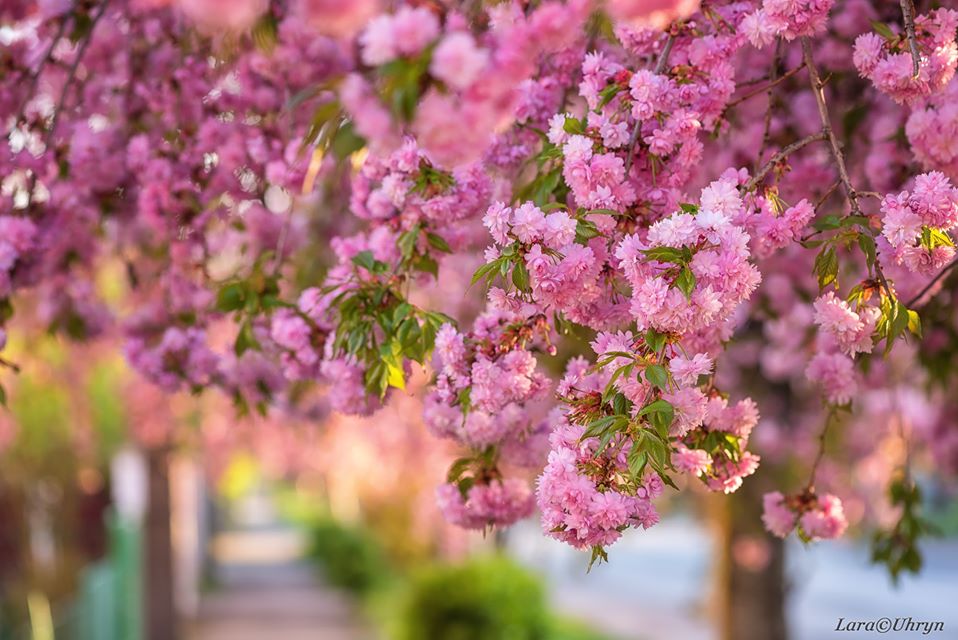
Along with the local species, the Uzhhorod region is also home to numerous exotic flora. There are more than 300 species of exotic plants here. From early spring to late autumn, the flowering of some plants is replaced by others. It seems that the settlements dissolve into flowering trees and bushes. These are such original plants as golden and greenish forsythia bushes, pale pink flowers of Japanese quince and pink flowers of Niedzwiecki apple trees, blood-red flowers of Florida apple trees and white flowers of Chinese apple trees, pink buds of Japanese sakura flowers, blond and reddish flowering shoots of chestnut trees. There are also cypress trees, Himalayan pines, Douglas firs, evergreen boxwood, common scumpia (wig tree), lilac-leaved catalpa (cigar tree), and fluffy paulownia (Adam's tree).
Speaking about exotic plants of the Uzhhorod region, it is worth mentioning a tree from distant China - the magnolia ("cucumber tree"). There are several species of magnolia in our region: the pink magnolia 'Sulanja', the white magnolia 'Cobus' and the purple magnolia 'Lenne'. By the way, science has proven that a magnolia flower has a temperature inside that is higher than the temperature of the surrounding air. Try to see for yourself by putting your hand on a magnolia flower.
What to see?
The largest meadow in the Ukrainian Carpathians is the Runa (Rivne) meadow.
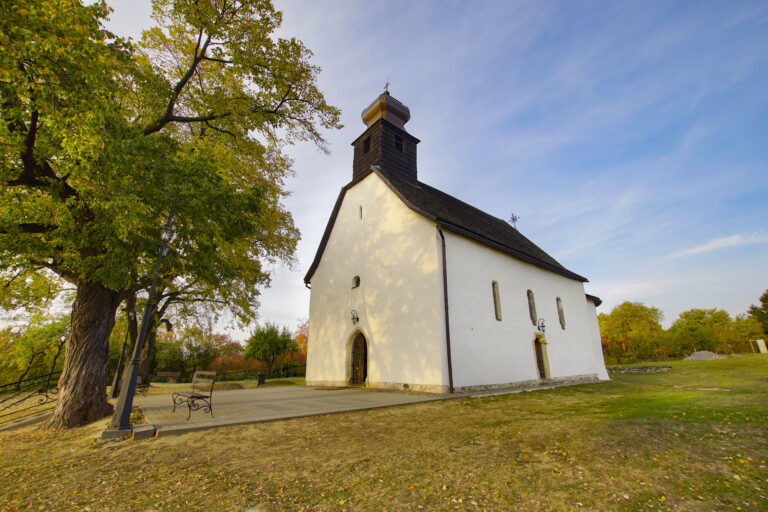
Unique wooden church in the village of LikitsaryThe church was built of spruce in the 17th century and rebuilt in 1748. The log cabins were covered with a gable roof. The porch and roof have a profiled cornice made of solid timber. A low square tower with a Baroque ending is located above the chancel. A small dome similar to the tower crowns the roof ridge above the altar.
Monument to the postman. In the village of Turyi Remety (10 km from Perechyn), there is a historical monument of the XIX century - a memorial plaque to the postman, made and installed by grateful countrymen who highly appreciated the life feat of postman Theodore Fekete, which he performed in the distant past. And in the very centre of Perechyn there is a monument to the postman, which is included in the list of "Original Monuments of Transcarpathia" compiled by the Tourist Information Centre of Transcarpathia.
Transcarpathian French. An interesting fact from the history of Perechyn district is that the inhabitants of Turya Remeta, one of the largest settlements in the district, are called "zhablars" by the residents of neighbouring villages. And indeed... If you look at the menu of one of the village's cafes, you will see two traditional dishes: "frog legs" and "turtle soup". Surprisingly, according to history, during Napoleon's invasion, captured French soldiers were quartered in the village, and they stayed there, creating their own families and passing on their French customs (including cuisine) to the local population.
During the Czechoslovak Republic, the founders of the Transcarpathian school of painting, artists Yosyp Bokshai and Adalbert Erdeli, chose Zhornava village Uzhhorod district as a place for his works. The village is also known as the Transcarpathian Barbizon (the name of the French village where the artists Rousseau, Corot, and Millet lived and worked). Since then, the breathtaking landscapes around Zhornava have gone down in history, as they were captured by the brushes of the great masters on their majestic canvases
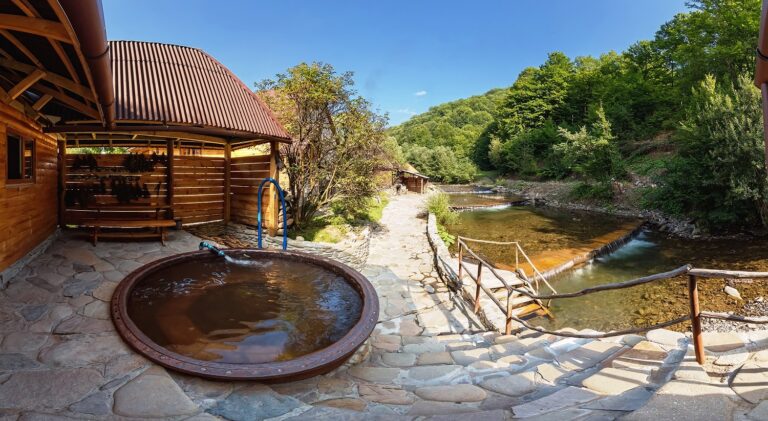
Vats in the village of Lumshory. Residents and guests of the region have a unique opportunity to dip into a 1000-litre vat heated by a fire with healing mineral waters at a temperature of up to +40-45°C.
Schönborn Park, in the Voevodyno tract. Unique park, lake and sculptures.
The 17th-century Church of St Michael the Archangel in the village of Uzhok is a UNESCO World Heritage Site. This is one of the most famous wooden churches in Transcarpathia, located in the village of Uzhok, under the Uzhok Pass. It was built in honour of St Michael the Archangel in 1745 and has been serving as a place of communion with God ever since;
The railway infrastructure built during the Austro-Hungarian Empire (early 20th century) by the Hungarian Royal State Roads is also interesting;
Established in 1999, Uzhansky National Nature Park covers an area of about 40,000 hectares and is located in the Uzh River basin from the village of Zabrid to the Uzhok Pass and is part of the Eastern Carpathians International Biosphere Reserve;
The area around the villages of Stuzhytsia and Uzhok is the site of the oldest forest beech reserves (1908). It is here that beech forests covering an area of over 55 hectares have been preserved. UNESCO heritage;
Uzhok pass (883 m). This is one of the ways to get to Zakarpattia from the Lviv region and the border with Poland (Sambir direction);
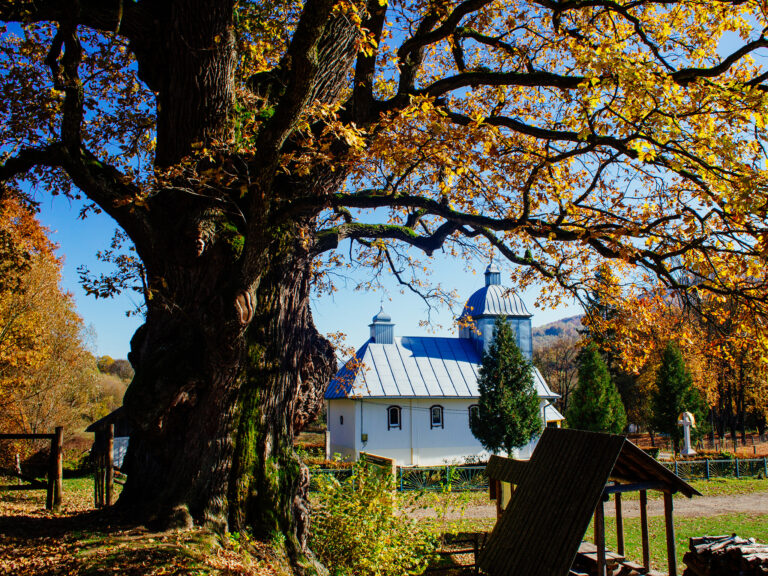
The oldest trees in Ukraine - "Dido Oak" and "Champion Oak" in the village of Stuzhytsia. The oaks are 1200 years old
Black Mlaky tract - the place of the crash Knyanina meteorite. On 9 June 1866, at 16:05 local time, the largest meteorite in Europe fell near the village of Knyahynya. The events unfolded between the Stinka and Yavirnyk ridges. The meteorite appeared as a fireball over the town of Liptovsky Mikulas, flew eastwards over the Slovak towns of Šaríš, Zemplín, and Pryšov, and after travelling over 200 km, exploded near the village of Kniahynya at an altitude of 40 km.
Uzhhorod district is also home to the Krasiya ski area in Zakarpattia.
The longest railway tunnel in Uzhhorod district is the 908-metre-long Shcherbyn-Sianky tunnel. The tunnel connects Transcarpathia and Lviv region.
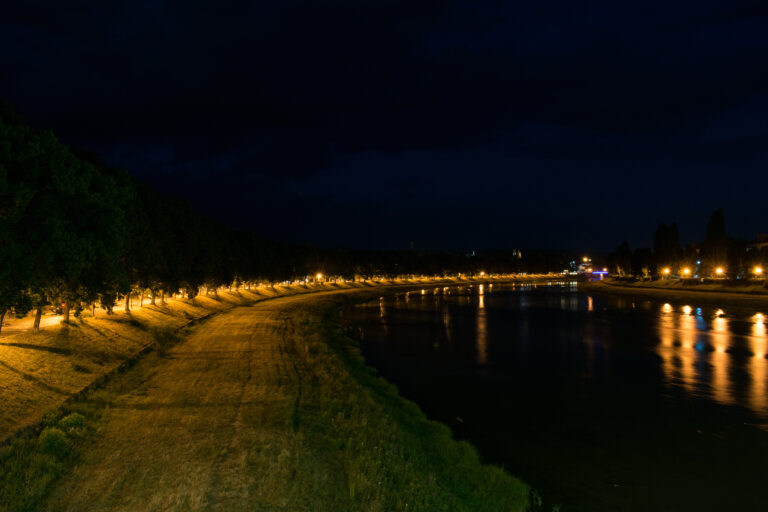
In Uzhhorod there are Europe's longest linden avenue (Nezalezhnist embankment).
There are many ancient parks and squares in Uzhhorod district: Uzhhorod - Laudon Park, Pidzamkovyi Park; V. Lazy - Ploteni Park; Cherteshch - 1848 Park;
Tourists in Uzhhorod and Uzhhorod district can visit numerous architectural monuments: Uzhhorod Castle (XI century), Nevytsky Castle (XII-XIV centuries) in the village of Kamyanytsia, Serednyansky Castle (XII-XIII centuries) and Wine Cellars (XVI century) in the village of Serednye, the Manor House (XVIII-XIX centuries) and Arboretum (XX century) in the village of Chertezh, Ploteni Palace with a park (XIX century) in the village of Velyki Lazy.
In addition, it is worth seeing the unique ancient churches of Uzhhorod and the Horyany Rotunda, as well as numerous museums: the local history museum in Uzhhorod Castle, the Museum of Architecture and Life, the Art Museum, the memorial art museums (Kotska, Manaila, Gluck), and the Zoological Museum.
The traditions of the Lemkos of Zakarpattia are best preserved in Uzhhorod district. Namely, their customs, rituals and cuisine. It is worth visiting the Lemko Manor House Museum in the village of Zarichevo and the author's Museum of Life and Customs "Sklad" in Dubrynychi.
We can also mention natural parks and reserves, namely: "Shipot", where unique plant species are protected; "Sokolovi rocks" in the Shipot River basin; and the state hydrological monument-waterfall in the village of Turya Polyana.
Treatment and rehabilitation of tourists in Uzhhorod district is provided by sanatoriums and resorts, accommodation - by hotels, campsites, motels, hostels, rural estates, food - by numerous restaurants, taverns and pubs.

